The Diffusion of Innovations (DOI) theory in contemporary marketing
The Concept:
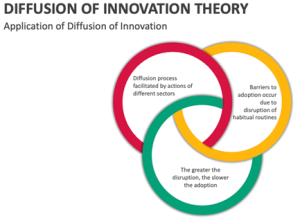
- The Diffusion of Innovation theory, developed by Everett Rogers (1962), explains how new ideas, products, or technologies spread within a social system over time. It’s highly relevant to modern marketing, especially in the age of digital transformation and social media.
The Diffusion of Innovations (DOI) theory explains how new ideas, products, or technologies spread through a social system over time, identifying adopter categories (Innovators, Early Adopters, Early Majority, Late Majority, Laggards) and product characteristics (Relative Advantage, Compatibility, Complexity, Trialability, Observability) that influence adoption rates. In contemporary marketing, the theory helps companies understand consum
er adoption patterns to design targeted marketing campaigns, predict success, and develop products with better market fit by leveraging influencers and addressing barriers like complexity.
Eements:
- The Innovation:The new product, service, or idea itself. A product, service, or idea perceived as new (e.g., AI tools, electric cars, wearable health tech).
- The Social System:The population or group of people who adopt the innovation.
- Communication Channels:How information about the innovation is spread and communicated. (ads, influencers, word-of-mouth, social media).
- Time:The speed and rate at which the innovation spreads. The adoption rate across different groups.
- Social System – The community, culture, or market influencing adoption.
- Adopter Categories:The different types of people who adopt an innovation, based on their timing:
- Innovators:The first to adopt, risk-takers eager to try new things. Innovators (2.5%) Tech enthusiasts, risk-takers (e.g., early buyers of VR headsets).
- Early Adopters:Opinion leaders who adopt early and are respected by others. Early Adopters (13.5%) – Opinion leaders who influence others (e.g., influencers reviewing Tesla).
- Early Majority:Adopt new ideas just before the average person. Early Majority (34%) – Pragmatic users who adopt once benefits are clear.
- Late Majority:Adopt once the majority of people have already adopted. Late Majority (34%) – Skeptics, adopt due to pressure or necessity.
- Laggards:The last to adopt, often skeptical and tradition-bound. Laggards (16%) – Last to adopt, often resistant until old products phase out.

actors Influencing Adoption (The Five Characteristics of Innovation)
- Relative Advantage: The degree to which an innovation is perceived as better than the idea it supersedes.
- Compatibility: The extent to which an innovation is perceived as consistent with existing values, experiences, and needs of potential adopters.
- Complexity: The degree to which an innovation is perceived as difficult to understand and use.
- Trialability: The degree to which an innovation may be experimented with on a limited basis.
- Observability: The degree to which the results of an innovation are visible to others.
Application in Contemporary Marketing
- Predicting Success: By understanding the characteristics of adopters and the innovation, marketers can better predict the potential success or failure of a new product.
- Developing Targeted Campaigns: Companies can tailor marketing messages and strategies to different adopter categories. For example, they can use Influencer marketing to reach Early Adopters or focus on benefits and advantages for the Early Majority.
- Designing Marketable Products: Marketers can also use the theory to design products that are more compatible, easier to try (trialable), and simpler to understand (less complex) to accelerate adoption.
- Understanding Adoption Rates: The theory provides a framework for understanding why and how quickly a new product or service gains traction in a specific market.
- Digital Product Launches – Tech companies like Apple or Samsung target innovators with hype events, then rely on early adopters to spread influence.
- Social Media & Influencer Marketing – Influencers accelerate diffusion by acting as early adopters/opinion leaders. Early adopters often serve as influencers who can sway opinion and accelerate adoption through their networks.
- Freemium & Trial Models – Common in SaaS (Spotify, Canva) to attract innovators/early adopters before scaling.
- Sustainability & Green Marketing – Electric vehicles (Tesla, BYD) and eco-friendly products spread via early adopters pushing societal change.
- Viral Marketing & Network Effects – Platforms like TikTok, Instagram, and Clubhouse grew rapidly due to innovators and early adopters creating content that pulled in the early majority.
- AI & Emerging Tech – Businesses use diffusion insights to predict how fast innovations like ChatGPT, VR, or blockchain will be embraced.
- Product Strategy: Understanding the adoption curve helps companies determine when to launch, iterate, or discontinue products to appeal to different segments over time.
- Targeted Communication: Marketers can tailor their messaging to the specific characteristics and motivations of each adopter group.
- Market Penetration: The theory provides a framework for understanding how a product moves from niche adoption to mass-market acceptance.
- Brand Building: By successfully navigating the diffusion process, companies can build brand credibility and trust across different consumer segments.
Why It Matters Today
- Helps marketers segment audiences and target campaigns effectively.
- Guides adoption strategies (e.g., influencer seeding, free trials).
- Useful in forecasting market penetration of new products.
- Provides insight into how social proof and peer influence accelerate adoption.
Challenges and adaptations of DOI in the modern era
- Accelerated diffusion: The speed of digital communication can compress the adoption curve. Social media can spread awareness instantly, but a lack of critical mass can also lead to faster obsolescence.
- Pro-innovation bias:The theory’s assumption that all innovations are positive ignores that consumers can actively resist a product, even a superior one, due to cost, risk, or lack of compatibility with existing values.
- Cultural and contextual factors: The internet has created a global social system, and cultural values can significantly affect adoption rates. What works in one country or subculture may not in another.
- Complexity of decision-making: The decision-making process is not always linear. Consumers can skip stages or reverse their decision, influenced by the complex flow of information online.
*********