Theories and Research of Second Language Acquisition (SL
A) is the field that studies how people learn languages beyond their mother tongue. It seeks to explain the processes, stages, and factors that affect learning a new language and why some learners succeed while others struggle. Theories and research in SLA draw from linguistics, psychology, sociology, and education.
1. Early Foundations of SLA
-
SLA research has roots in both behaviorist psychology and structural linguistics (1940s–1950s).
-
Language was viewed as a system of habits formed through imitation, practice, and reinforcement.
-
Behaviorism (Skinner’s view): Language learning = habit formation → errors seen as bad habits.
-
But Chomsky’s theory of Universal Grammar (UG) challenged this view, stressing innate ability.
2. Major Theoretical Approaches
(a) Behaviorist Theories
-
Key Figures: B.F. Skinner.
-
Language learning = stimulus-response-reinforcement cycle.
-
L2 learning seen as transferring L1 habits → interference errors.
-
Weakness: cannot explain creative use of language or rapid child acquisition.
(b) Innatist Theories
-
Key Figures: Noam Chomsky, Stephen Krashen.
-
Humans have an innate Language Acquisition Device (LAD) → explains how children acquire L1 quickly.
-
In SLA:
-
Learners use internal mechanisms to construct grammar rules.
-
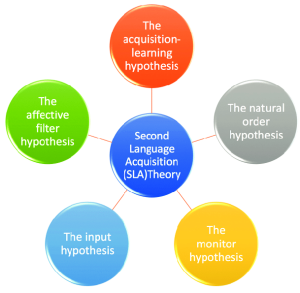
Krashen’s Monitor Model:
-
Acquisition vs. Learning – subconscious vs. conscious processes.
-
Monitor Hypothesis – learned rules only edit output.
-
Natural Order Hypothesis – grammar acquired in predictable sequences.
-
Input Hypothesis – comprehensible input (i+1) is essential.
-
Affective Filter Hypothesis – anxiety, motivation, and attitudes influence success.
-
-
-
Strength: explains learner creativity, predictable stages.
-
Criticism: too broad, difficult to test empirically.
(c) Cognitive Theories
-
Language learning = general learning, not special mechanisms.
-
Information Processing: Learners move from controlled → automatic processing.
-
Connectionism: Learners build associations through repeated exposure to input.
-
Noticing Hypothesis (Schmidt): Learners must consciously notice features to acquire them.
-
Working Memory Role: Affects processing and retention.
-
Emphasis on practice, attention, and memory.
(d) Interactionist Theories
-
Learning arises through interaction and negotiation of meaning.
-
Long’s Interaction Hypothesis: Comprehensible input + interaction helps modify input.
-
Swain’s Output Hypothesis: Production (speaking/writing) is essential → forces learners to process language deeply.
-
Vygotsky’s Sociocultural Theory: Zone of Proximal Development (ZPD) → scaffolding from more competent peers/teachers enables progress.
-
Learning is both social and cognitive.
3. Key Research Findings
Interlanguage
-
Coined by Selinker (1972).
-
Learners create an evolving system → influenced by L1 but rule-governed.
-
Includes:
-
Fossilization – errors become permanent.
-
Transfer – L1 influence (positive or negative).
-
Developmental Sequences
-
L2 learners follow u
-
niversal stages in acquiring grammar (e.g., negation, question formation).
-
Errors reflect natural progression, not failure.
Input and Output Studies
-
Rich, meaningful input improves comprehension.
-
Interaction and corrective feedback enhance accuracy.
-
Output tasks help consolidate grammar and vocabulary.
Individual Differences
-
Factors influencing SLA success:
-
Age – youn
-
ger learners acquire pronunciation better; older learners may learn grammar faster.
-
Motivation – integrative (desire to integrate with culture) vs. instrumental (career/academic goals).
-
Personality – extroverts may practice more; introverts may excel in accuracy.
-
Learning Styles & Strategies – visual, auditory, kinesthetic, metacognitive strategies.
-
Aptitude – working memory, phonemic coding, and analytical skills.
-
Affective Fac
-
tors – anxiety, self-confidence, empathy.
-
4. Classroom Implications
-
SLA research impacts language teaching:
-
Input-rich environments are vital.
-
Interaction and group work support learning.
-
Corrective feedback (explicit and implicit) helps development.
-
Task-based learning promotes meaningful communication.
-
Teachers should consider individual learner differences.
-
5. Current Trends in SLA Research
-
Usage-based approaches: Language emerges from patterns of usage.
-
Dynamic Systems Theory: SLA is nonlinear, constantly adapting.
-
Technology and SLA: Online interaction, AI tools, and computer-assisted language learning.
-
Bilingualism/Multilingualism studies: Code-switching, translanguaging.
-
Neurolinguistic research: Brain imaging reveals processing differences in L1 vs. L2.
📌 Conclusion
-
SLA = study of how people learn additional languages beyond L1.
-
Early view: Behaviorism → language = habit formation.
-
Chomsky’s Innatism → humans have innate capacity for language.
-
Krashen’s Monitor Model → acquisition vs. learning, comprehensible input, affective filter.
-
Cognitive views → focus on attention, memory, processing, noticing.
-
Interactionist views → language develops through communication, negotiation, scaffolding.
-
Interlanguage → learner’s evolving internal grammar; includes fossilization & transfer.
-
Learners pass through universal developmental stages in L2 grammar.
-
Key factors affecting SLA:
-
Age, aptitude, motivation, personality, learning style, affective filter.
-
-
Teaching implications:
-
Rich input, interactive tasks, corrective feedback, learner-centered methods.
-
-
Current trends:
-
Usage-based, dynamic systems, technology in SLA, neurolinguistics, multilingual perspectives.
-