What is Big Data?
Big data refers to massive, complex, and rapidly growing datasets that exceed the processing capabilities of traditional data management too
ls. Your definition is spot-on—it encompasses data that requires specialized technologies for storage, processing, and analysis to extract meaningful insights.
Big Data refers to vast and rapidly growing volumes of data that are too large and complex for traditional data processing tools to manage. This data comes in many forms structured (e.g., tables), semi-structured (e.g., JSON, XML), and unstructured (e.g., text, images, video).
With the explosion of devices, sensors, online services, and digital platforms, data is now generated at an unprecedented rate. This growth makes it essenti
al for organizations to adopt advanced tools and technologies to capture, store, analyze, and utilize this data effectively.
The 5 V’s of Big Data
- Volume: Beyond petabytes, organizations now handle exabytes of data
- Velocity: The widespread adoption of smart devices, the ubiquity of social media, and the deployment of countless sensors drive unprecedented data integration in 2025 The Future of Data Analytics: Trends in 7 Industries [2025]
- Variety: Now includes multimodal data from IoT sensors, voice recordings, and real-time streaming
- Veracity: Enhanced by AI-powered data quality tools
- Value: Mastering these technologies empowers organizations to transform raw data into valuable assets, driving competitive Big Data Technologies: Tools, Solutions, and Trends for 2025 | DataCamp advantage
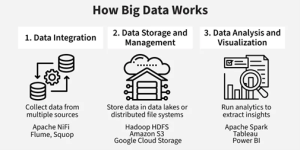
How Big Data Works
Your three-step process is fundamentally correct, but modern implementations have evolved:
1. Enhanced Integration: The mainstream adoption of large language models (LLMs) and generative AI tools has democratized access to advanced analytics capabilities Top Trends in Big Data for 2025 and Beyond | Informa TechTarget, making data integration more intelligent and automated.
2. Advanced Storage Solutions: Cloud-native architectures now dominate, with hybrid and multi-cloud strategies becoming standard.
3. AI-Powered Analysis: Traditional descriptive, predictive, and prescriptive analytics now incorporate generative AI and multimodal analysis capabilities.
Core Big Data Technologies
| Tool | Purpose |
| Hadoop | Distributed storage and batch processing |
| Apache Spark | In-memory fast data processing |
| Kafka | Real-time data streaming |
| Hive & Pig | Querying and analyzing big datasets |
| NoSQL Databases | Scalable databases (e.g., MongoDB, Cassandra) |
| Data Lakes | Store raw data in any format for future use |
Current Market Growth and Investment
Valued at $150.22 billion in 2024, it’s expected to grow to $174.10 billion in 2025, with projections reaching 6.51 billion by 2034, reflecting a CAGR of 16.2% Top 9 Data Science Trends to Watch in 2025. This explosive growth reflects increasing organizational commitment to data-driven strategies.
Expanded Real-World Applications
Your industry examples are accurate. Here are additional contemporary applications:
Healthcare (Enhanced): 56% of healthcare centers have adopted predictive analysis, with higher rates in some countries like Singapore (92%) Top 9 Data Science Trends to Watch in 2025, demonstrating widespread adoption beyond your initial description.
Transportation and Logistics: Real-time route optimization using traffic patterns, weather data, and delivery schedules to reduce fuel consumption and improve delivery times.
Agriculture: Precision farming using satellite imagery, soil sensors, and weather data to optimize crop yields while minimizing resource usage.
Smart Cities: Integration of traffic management, energy consumption, waste management, and public safety data to improve urban living conditions.
Cybersecurity: Real-time threat detection and response systems that analyze network traffic patterns, user behavior, and threat intelligence feeds.
Emerging Technologies and Trends for 2025
Edge Computing Integration: Processing data closer to its source reduces latency and bandwidth requirements while enabling real-time decision-making in IoT applications.
Quantum Computing Impact: advances in the development of multimodal AI models and quantum computing are beginning to influence long-term strategic planning Top Trends in Big Data for 2025 and Beyond | Informa TechTarget for complex optimization problems.
Data-as-a-Service (DaaS): Organizations increasingly purchase specific datasets rather than collecting all data internally, creating new business models around data monetization.
Automated Machine Learning (AutoML): Democratizing data science by enabling non-technical users to build and deploy machine learning models.
Privacy-Preserving Analytics: Techniques like federated learning and differential privacy enable insights while protecting individual privacy.
Implementation Challenges and Solutions
Data Governance: Establishing policies for data quality, security, and compliance across distributed systems.
Skills Gap: Approximately 55% of companies planned to increase their AI data science budgets by 25% or more in 2024 Top 9 Data Science Trends to Watch in 2025, partly to address talent shortages.
Cost Management: Optimizing cloud storage and processing costs while scaling analytics capabilities.
Integration Complexity: Managing data pipelines across multiple platforms and ensuring data consistency.
Strategic Business Impact
Decision-Making Speed: Real-time analytics enable faster strategic pivots and operational adjustments.
Customer Experience: Personalization engines create individualized experiences across touchpoints.
Operational Efficiency: Predictive maintenance and supply chain optimization reduce costs and improve reliability.
Innovation Driver: Data insights fuel product development and new business model creation.
Future Outlook
Big data is continuing to proliferate at organizations, this time spurred by AI and machine learning within enterprise software tools, followed by advancements in software for managing unstructured data Trend-Setting Products in Data and Information Management for 2025 – Database Trends and Applications. The convergence of big data with artificial intelligence is creating unprecedented opportunities for organizations to gain competitive advantages through data-driven insights.
Environmental Considerations: Growing focus on sustainable data practices, including energy-efficient data centers and carbon footprint optimization.
Regulatory Evolution: Increasing data protection regulations worldwide are shaping how organizations collect, process, and store big data.
Your foundational understanding of big data is excellent and remains relevant. The key evolution is the integration of AI technologies that are making big data more accessible, automated, and valuable for organizations across all industries.