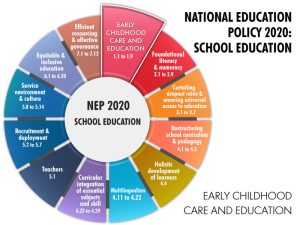
The Union Cabinet approved the National Education Policy (NEP) in July 2020, marking the third major reform of India’s education framework after the earlier policies of 1968 and 1986. It also renamed the Ministry of Human Resource Development (MHRD) to the Ministry of Education.
The policy envisions making India a global knowledge superpower through reforms from early childhood care to higher education.
Background
-
Draft prepared by a committee chaired by Dr. K. Kasturirangan (2017–2019).
-
Submitted in May 2019, ap
-
proved in July 2020.
-
First comprehensive education policy of the 21st century.
-
Builds upon ancient Indian knowledge traditions (Charaka, Aryabhata, Panini, etc.) while aiming for modern inclusivity and innovation.
Core Principles
-
Flexibility in curriculum and learning paths
-
No rigid separation of academic disciplines
-
Multidisciplinary approach
-
Emphasis on critical thinking, conceptual clarity, and ethical values
-
Teachers as the “heart of the learning process”
-
Strong public education system as a foundation
Features of NEP 2020
Addresses the “5 pillars” of education: Access, Equity, Quality, Affordability, Accountability.
Key reforms:
-
Restructuring of school curriculum into 5+3+3+4 model.
-
Focus on Early Childhood Care and Education (ECCE).
-
Expansion of Right to Education Act (RTE) to cover ages 3–18.
-
Exam reforms: competency-based testing, census exams in classes 3, 5, 8; redesigned board exams.
-
Emphasis on vocational training and skill development from school level.
-
Higher education governance:
-
NHERA as single regulator
-
National Research Foundation (NRF) for research promotion
-
Rashtriya Shiksha Aayog (National Education Commission) to guide policy
-
-
Target: 6% of GDP investment in education.
-
Integration of technology via the National Education Technology Forum.
Key Recommendations
-
Early Childhood Care & Education – Strengthening Anganwadi & primary school linkages.
-
Curriculum Reform – 5+3+3+4 system replacing 10+2.
-
Three-Language Formula – Flexibility for states; inclusion of regional languages.
-
Higher Education – Graded autonomy, multidisciplinary universities, phasing out of affiliated colleges.
-
Research – National Research Foundation to mentor & fund quality projects.
-
Governance – Rashtriya Shiksha Aayog chaired by the PM.
-
Financing – Doubling current public expenditure on education.
-
Vocational Education – Mandatory exposure for classes 9–12; integration into UG programmes.
Merits
-
Holistic and comprehensive approach (preschool to doctoral education).
-
Recognises importance of foundational years (ages 3–8).
-
Promotes autonomy, reduces rigid regulations.
-
Encourages inclusivity through Inclusion Funds.
-
Strengthens India’s research ecosystem.
Concerns
-
Implementation challenges, especially in rural Anganwadi systems.
-
Over-reliance on volunteers and peer tutoring.
-
Possible dilution of university autonomy via National Testing Agency (NTA).
-
Lack of clarity in strategy for government schools and state-run institutions.
-
Risk of over-centralisation in governance.
UGC NET Relevance
-
Important for GS 2 (Governance, Polity, Education) & Essay Paper.
-
Frequently discussed in PIB, Y
-
ojana, Kurukshetra.
-
Related programmes: NIPUN Bharat (2021), Samagra Shiksha Abhiyan, RTE Act, etc.
Sample UPSC Questions
Q1. Who chaired the committee that drafted NEP 2020?
→ Dr. K. Kasturirangan
Q2. List the years in which National Education Policies were adopted.
→ 1968, 1986, 1992 (modified), 2020