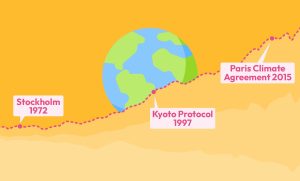
Major International Environmental Agreements
Since the mid-twentieth century, growing awareness of environmental degradation has compelled nations across the world to cooperate on a global scale.
Five landmark international frameworks — the Stockholm Conference (UNCHE), the Earth Summit (UNCED), the Montreal Protocol, the Kyoto Protocol, and the Paris Agreement — together form the backbone of international environmental law and diplomacy. Each reflects the political, scientific, and social climate of its era and has shaped how humanity approaches ecological crises.
Stockholm Conference (UNCHE) — 1972
The United Nations Conference on the Human Environment, held in Stockholm, Sweden, from June 5–16, 1972, was the first major international gathering focused entirely on environmental issues.
- Full Name: United Nations Conference on the Human Environment (UNCHE).
- Date & Venue: June 5–16, 1972, Stockholm, Sweden.
- Participants: Representatives from 113 countries attended, making it the largest environmental summit of its time.
- Driving Force: Growing industrial pollution, acid rain, and ecological disasters of the 1960s-70s forced governments to act collectively.
- Stockholm Declaration: The conference adopted the Stockholm Declaration, consisting of 26 principles emphasizing the human right to a healthy environment and the responsibility of states to protect it.
- Action Plan: An Action Plan for the Human Environment was adopted with 109 recommendations covering environmental assessment, management, and international measures.
- UNEP Established: The United Nations Environment Programme (UNEP) was created as a direct outcome — a permanent UN body headquartered in Nairobi, Kenya, to coordinate global environmental action.
- World Environment Day: June 5 was designated World Environment Day, observed globally each year since 1973.
- Principle 21: Nations were affirmed to have the sovereign right to exploit their own natural resources, but the responsibility to ensure their activities do not damage the environment of other states.
- Legacy: Stockholm is considered the birth of modern international environmental governance. It sparked a wave of national environmental agencies and legislation worldwide.
Earth Summit (UNCED) — 1992
The United Nations Conference on Environment and Development (UNCED), known as the Earth Summit, was held in Rio de Janeiro, Brazil, in June 1992. It was the largest intergovernmental conference ever held at that time.
- Full Name: United Nations Conference on Environment and Development (UNCED).
- Date & Venue: June 3–14, 1992, Rio de Janeiro, Brazil.
- Scale: 172 governments participated, with 108 heads of state, and over 2,400 NGO representatives attended.
- Rio Declaration: Adopted 27 principles affirming the right to development alongside environmental protection, including the Precautionary Principle and Polluter Pays Principle.
- Agenda 21: A comprehensive 300-page action plan for sustainable development in the 21st century, covering social, economic, and environmental dimensions — a landmark blueprint for global cooperation.
- UNFCCC: The United Nations Framework Convention on Climate Change (UNFCCC) was opened for signature — the treaty that would later give birth to the Kyoto Protocol and Paris Agreement.
- Convention on Biological Diversity (CBD): Opened for signature, aiming to conserve biodiversity, promote sustainable use, and ensure fair sharing of genetic resources.
- Forest Principles: A non-legally binding statement of principles for the management, conservation, and sustainable development of all types of forests.
- Commission on Sustainable Development: A new UN body was created to monitor and report on implementation of Agenda 21.
- North-South Divide: The summit highlighted tensions between developed (North) and developing (South) nations over responsibility, funding, and technology transfer for environmental protection.
- Legacy: Rio 1992 mainstreamed ‘sustainable development’ as a global policy goal. It led to Rio+10 (Johannesburg, 2002) and Rio+20 (2012), perpetuating its vision.
Montreal Protocol — 1987
The Montreal Protocol on Substances that Deplete the Ozone Layer is widely regarded as the most successful international environmental agreement in history. It remains the only UN treaty ratified by every country on Earth.
- Full Name: Montreal Protocol on Substances that Deplete the Ozone Layer.
- Adopted: September 16, 1987, in Montreal, Canada.
- Entry into Force: January 1, 1989.
- Universal Ratification: As of today, all 198 UN member states have ratified the Protocol — the first treaty in UN history to achieve universal ratification.
- Target: To phase out the production and consumption of Ozone Depleting Substances (ODS), particularly chlorofluorocarbons (CFCs), halons, carbon tetrachloride, and methyl chloroform.
- Scientific Basis: Triggered by the discovery of the ‘ozone hole’ over Antarctica by British scientists in 1985, and earlier research by Molina and Rowland in 1974.
- Phase-out Schedule: Developed nations phased out CFCs by 1996; developing nations had extended timelines. Each chemical class had a specific schedule.
- Kigali Amendment (2016): A landmark addition that added hydrofluorocarbons (HFCs) — used as CFC replacements but powerful greenhouse gases — to the phase-out list, linking ozone protection with climate action.
- Multilateral Fund: Established in 1991 to assist developing countries with the costs of phasing out ODS through financial and technical support.
- Results: The ozone layer is on track for full recovery by approximately 2060–2065. An estimated 2 million cases of skin cancer are prevented annually.
- Legacy: The Montreal Protocol demonstrates that global environmental problems can be solved with science-based, economically supported international cooperation.
Kyoto Protocol — 1997
The Kyoto Protocol was the first legally binding international treaty to set quantified greenhouse gas (GHG) emission reduction targets for developed countries, operationalizing the UNFCCC.
- Full Name: Kyoto Protocol to the United Nations Framework Convention on Climate Change.
- Adopted: December 11, 1997, in Kyoto, Japan.
- Entry into Force: February 16, 2005, after Russia’s ratification provided the required threshold.
- Principle: Based on ‘Common But Differentiated Responsibilities (CBDR)’ — recognizing that developed nations bear greater historical responsibility for climate change.
- Annex I Countries: Industrialized nations (Annex I) were assigned binding emission reduction targets; developing nations (including China and India) had no binding targets.
- First Commitment Period: 2008–2012: Annex I countries collectively committed to reducing GHG emissions by at least 5% below 1990 levels.
- Second Commitment Period: 2013–2020 (Doha Amendment): Extended targets, though participation was reduced as Canada withdrew and the US never ratified.
- Flexible Mechanisms: Three market-based tools were introduced: (1) Emissions Trading (carbon market), (2) Clean Development Mechanism (CDM) allowing investment in developing countries, and (3) Joint Implementation (JI) between developed nations.
- US Non-ratification: The United States, the largest emitter at the time, signed but never ratified the Protocol — a major blow to its effectiveness.
- Limitations: Covered only ~12% of global emissions, excluded major developing emitters, and faced compliance challenges without enforcement mechanisms.
- Legacy: Despite weaknesses, Kyoto established the architecture of carbon accounting, emission trading, and the legal framework that preceded the Paris Agreement.
Paris Agreement — 2015
The Paris Agreement represents the most ambitious and inclusive international climate treaty to date, replacing the Kyoto Protocol as the primary framework for global climate action under the UNFCCC.
- Full Name: Paris Agreement under the United Nations Framework Convention on Climate Change.
- Adopted: December 12, 2015, at COP21, Paris, France.
- Entry into Force: November 4, 2016 — record speed for an international treaty.
- Parties: 196 parties have signed; 195 have ratified as of 2024.
- Temperature Goal: Limit global average temperature rise to well below 2°C above pre-industrial levels, and pursue efforts to limit it to 1.5°C.
- Nationally Determined Contributions (NDCs): Each country submits its own climate action plan (NDC); these are voluntary but must be progressively ambitious over time — a ‘bottom-up’ approach differing from Kyoto’s ‘top-down’ targets.
- Global Stocktake: Every 5 years, all parties collectively assess progress and ratchet up ambition — the first Global Stocktake occurred in 2023.
- Net-Zero Goal: Calls for global net-zero greenhouse gas emissions in the second half of the 21st century, requiring carbon neutrality.
- Climate Finance: Developed countries committed to mobilizing $100 billion annually by 2020 to assist developing countries — a goal largely unmet, with a new collective quantified goal being negotiated.
- Loss and Damage: Recognized the concept of addressing loss and damage caused by climate impacts, with a dedicated fund formally established at COP27 (2022).
- US Withdrawal & Re-entry: President Trump withdrew the US in 2017; President Biden rejoined in 2021 — highlighting the vulnerability of agreements to domestic politics.
- Legacy: The Paris Agreement is a historic diplomatic achievement — universal, legally registered, and scientifically grounded. However, current NDCs are still insufficient to meet the 1.5°C goal.
Conclusion
From the foundational principles of Stockholm (1972) to the ambitious climate targets of Paris (2015), the arc of international environmental diplomacy reflects humanity’s evolving understanding of planetary limits. The Stockholm Conference created the institutional framework; the Earth Summit embedded sustainable development; the Montreal Protocol proved global environmental action is possible; the Kyoto Protocol pioneered carbon markets and legal accountability; and the Paris Agreement attempts universal and flexible climate ambition. Together, these agreements form an interconnected legacy — imperfect, evolving, but indispensable — in the global effort to protect our shared environment for future generations.