Introduction
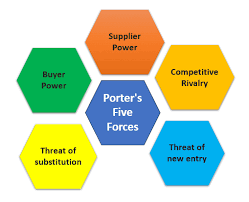
Michael Porter’s Five Forces Model, introduced in his 1979 Harvard Business Review article “How Competitive Forces Shape Strategy,” revolutionized strategic business analysis. Porter, a Harvard Business School professor, developed this framework to help organizations understand the competitive forces that determine industry profitability and attractiveness. The model moves beyond simple competitor analysis to examine the broader competitive environment, recognizing that profitability is influenced by multiple actors and market dynamics. Porter argues that the collective strength of these forces determines the ultimate profit potential of an industry, where profit potential is measured in terms of long-run return on invested capital.
The Five Forces Explained
1. Competitive Rivalry Among Existing Firms
Competitive rivalry refers to the intensity of competition among current players in an industry. This is often the most obvious force and the one managers focus on most directly. Porter suggests that rivalry is intense when numerous or equally balanced competitors exist, when industry growth is slow, when fixed costs are high, when products lack differentiation, when switching costs are low, or when exit barriers are high.
Detailed Concept: High rivalry leads to price wars, advertising battles, product introductions, and increased customer service—all of which can erode profitability. Slow industry growth turns competition into a market-share game, where growth comes only at a competitor’s expense. High fixed costs create pressure to fill capacity, often leading to price cutting. When products are perceived as commodities, buyers make decisions based primarily on price and service, intensifying price and service competition.
Author’s Examples: Porter cited industries like automobile manufacturing and personal computers as having intense rivalry due to numerous competitors, high fixed costs, and relatively standardized products.
Real-World Examples: The soft drink industry exemplifies intense competitive rivalry. Coca-Cola and PepsiCo have engaged in decades of fierce competition through aggressive pricing strategies, massive advertising campaigns (the “Cola Wars”), new product launches, and securing exclusive distribution contracts with restaurants and retailers. The airline industry also demonstrates extreme rivalry, with carriers competing intensely on price, routes, and loyalty programs. Southwest Airlines, Delta, United, and American Airlines constantly adjust pricing and services to capture market share, often resulting in thin profit margins across the industry.
2. Threat of New Entrants
The threat of new entrants examines how easy or difficult it is for new competitors to enter an industry. Porter identifies several entry barriers that protect established firms: economies of scale, product differentiation, capital requirements, switching costs, access to distribution channels, cost disadvantages independent of scale, and government policy.
Detailed Concept: Economies of scale deter entry by forcing new entrants to come in at large scale (risking strong reaction from existing firms) or accept a cost disadvantage. Product differentiation means established firms have brand identification and customer loyalty that newcomers must overcome through heavy investment. Capital requirements can be enormous in industries like pharmaceuticals or aerospace, deterring all but the most well-funded entrants. Access to distribution channels can be limited when existing firms have sewn up preferred distributors.
Author’s Examples: Porter highlighted brewing, where economies of scale in production, distribution, and marketing create substantial barriers. He also cited the mainframe computer industry, where IBM’s established relationships and reputation created formidable entry barriers.
Real-World Examples: The commercial aircraft manufacturing industry has extremely high barriers to entry. Boeing and Airbus dominate because entering requires billions in capital investment, decades of engineering expertise, complex supply chain development, and certification from aviation authorities worldwide. When China attempted to develop the COMAC C919 to compete with Boeing’s 737 and Airbus’s A320, it took over a decade and massive state investment, and the aircraft still struggles for international acceptance. Similarly, the pharmaceutical industry has high barriers including lengthy FDA approval processes, patent protections, substantial R&D costs (often exceeding $1 billion per drug), and established relationships between existing companies and healthcare providers.
3. Bargaining Power of Suppliers
Supplier power examines the pressure suppliers can place on businesses by raising prices, reducing quality, or limiting availability of their products. A supplier group is powerful if it’s dominated by few companies and is more concentrated than the industry it sells to, if it’s not obliged to contend with substitute products, if the industry is not an important customer to the supplier group, if the supplier’s product is an important input to the buyer’s business, if the supplier’s products are differentiated or switching costs are high, or if the supplier group poses a credible threat of forward integration.
Detailed Concept: When suppliers are powerful, they can squeeze profitability out of an industry unable to recover cost increases in its own prices. For instance, when there are few substitutes for what the supplier group provides, suppliers can exert considerable influence. Differentiated or switching-cost-intensive products also lock in buyers, giving suppliers more power.
Author’s Examples: Porter discussed the power of labor unions in certain industries, the power of supplier groups providing specialized components, and the influence of suppliers of unique raw materials.
Real-World Examples: Intel exemplifies strong supplier power in the PC manufacturing industry. For decades, Intel’s dominance in processor technology meant computer manufacturers like Dell, HP, and Lenovo had limited alternatives and had to accept Intel’s pricing and product release schedules. Intel’s “Intel Inside” marketing campaign further strengthened its position by creating end-user demand for Intel processors specifically. Another example is the pharmaceutical industry’s dependence on active pharmaceutical ingredient (API) suppliers. When only a few manufacturers produce specific APIs, they can command premium prices, especially for patented compounds. OPEC demonstrates supplier power in the oil industry, where coordinated production cuts can dramatically affect global oil prices and refinery profitability.
4. Bargaining Power of Buyers
Buyer power refers to the pressure customers can place on businesses, forcing prices down, demanding higher quality or more services, and playing competitors against each other. A buyer group is powerful if it’s concentrated or purchases large volumes relative to seller sales, if the products it purchases are standard or undifferentiated, if it faces few switching costs, if it earns low profits (creating incentive to lower purchasing costs), if buyers pose credible threat of backward integration, or if the product is unimportant to the quality of the buyer’s products or services.
Detailed Concept: Buyers compete with the industry by forcing down prices, bargaining for higher quality or more services, and playing competitors against each other. Powerful buyers can capture more value if the industry serves a few large customers versus many fragmented customers. When buyers purchase in large volumes, they are particularly important to sellers and can demand price concessions.
Author’s Examples: Porter cited the automobile industry’s relationship with its component suppliers, where large automakers like General Motors wielded significant buyer power over parts manufacturers.
Real-World Examples: Walmart exemplifies extreme buyer power. As the world’s largest retailer, Walmart’s enormous purchasing volume gives it tremendous leverage over suppliers. Manufacturers like Procter & Gamble, Unilever, and even large food producers must accept Walmart’s pricing demands, packaging requirements, and delivery schedules or risk losing access to millions of customers. Walmart’s sophisticated supply chain tracking and just-in-time inventory systems place additional operational demands on suppliers. Similarly, large hospital networks and pharmacy benefit managers like CVS Health and Express Scripts exercise significant buyer power over pharmaceutical manufacturers, negotiating substantial discounts and formulary placement in exchange for market access.
5. Threat of Substitute Products or Services
The threat of substitutes examines the likelihood that customers will switch to alternative products or services that serve the same function. Substitutes limit potential returns in an industry by placing a ceiling on prices. The more attractive the price-performance ratio of substitute products, the tighter the lid on industry profits.
Detailed Concept: Substitutes become particularly threatening when they offer an improvement in the price-performance trade-off relative to the industry’s product. Sometimes substitutes emerge from industries earning high profits or from industries pursuing strategies that will improve their price-performance. Porter emphasizes that strategists should pay particular attention to substitutes that are subject to trends improving their price-performance trade-off with the industry’s product or are produced by industries earning high profits.
Author’s Examples: Porter discussed sugar producers facing substitution from high-fructose corn syrup, and security services facing substitution from electronic alarm systems.
Real-World Examples: The entertainment industry demonstrates dramatic substitution effects. Streaming services like Netflix, Disney+, and Amazon Prime Video have substantially substituted traditional cable television. Consumers found the price-performance ratio more attractive—lower monthly costs, on-demand viewing, no commercials, and original content. This substitution devastated the cable industry, with millions of “cord-cutters” abandoning traditional packages. Similarly, video conferencing tools like Zoom and Microsoft Teams have substituted for business travel. During the COVID-19 pandemic, organizations discovered virtual meetings could effectively replace many in-person meetings at a fraction of the cost, fundamentally impacting the airline and hotel industries. Email and instant messaging substituted traditional postal services for personal communication, while digital photography substituted film photography, nearly destroying Kodak’s traditional business model.
Strategic Implications
Porter argues that understanding these five forces enables managers to identify their industry’s underlying structure, revealing the fundamental attractiveness of an industry and providing insight into which strategic changes might yield the best returns. Industries where all five forces are favorable (weak competitive rivalry, high barriers to entry, weak supplier and buyer power, few substitutes) offer greater profit potential than industries where one or more forces are unfavorable. However, even in unfavorable industries, companies can use strategic positioning to build defenses against competitive forces or find positions where forces are weakest.
Strategic Responses to Each Force
Against Competitive Rivalry: Companies can differentiate products, build brand loyalty, focus on niche markets, or pursue cost leadership. Apple differentiates through design and ecosystem integration, reducing direct price competition.
Against New Entrants: Firms can increase barriers through patents, exclusive contracts, economies of scale, or brand building. Pharmaceutical companies rely heavily on patent protection, while Amazon built massive distribution infrastructure that’s difficult to replicate.
Against Supplier Power: Organizations can develop multiple suppliers, backward integrate, or create standardized components. Toyota developed a robust multi-supplier network to reduce dependence on any single supplier.
Against Buyer Power: Companies can increase switching costs, differentiate products, or target fragmented customer bases. Adobe’s shift to subscription software (Creative Cloud) increased switching costs and reduced buyer power.
Against Substitutes: Firms can improve price-performance ratios, differentiate more strongly, or even embrace the substitute. Traditional taxi companies failed to respond to Uber’s substitution threat, while some hotels partnered with Airbnb rather than fighting it.
Limitations and Criticisms
While Porter’s Five Forces remains widely used, scholars have identified several limitations. The model presents a relatively static snapshot of industry structure, potentially overlooking dynamic changes and disruptive innovations. Critics argue it underemphasizes the role of complementary products and services—for instance, the smartphone industry’s success depends heavily on app ecosystems, which the model doesn’t explicitly address.
The framework also assumes relatively stable industry boundaries, which may not hold in today’s rapidly converging markets. Tesla, for example, operates simultaneously in automotive, energy storage, and solar industries, blurring traditional boundaries. Additionally, the model focuses primarily on competition and may undervalue collaboration, strategic alliances, and network effects that characterize many modern industries, particularly digital platforms.
Some strategists argue the model is too industry-focused and doesn’t adequately account for firm-specific resources and capabilities that create competitive advantage. The resource-based view of strategy emerged partly as a response to this perceived limitation.
Modern Applications and Adaptations
In the digital age, Porter’s framework requires careful adaptation. Platform businesses like Amazon, Google, and Facebook operate under different dynamics where network effects, data advantages, and multi-sided markets create new forms of competitive advantage. The “threat of new entrants” force must now consider digital-native startups that can scale globally with minimal capital investment.
The COVID-19 pandemic demonstrated how external shocks can rapidly reshape all five forces simultaneously. Remote work technologies saw reduced threat from substitutes, changed buyer-seller dynamics, and altered competitive rivalry as demand surged.
Despite these challenges, the Five Forces framework remains valuable for strategic analysis when used thoughtfully, often in combination with other analytical tools. Its enduring influence reflects Porter’s fundamental insight: industry structure matters profoundly for profitability, and understanding competitive forces is essential for strategic success.