
Motivation theories and their significance in contemporary environment
Motivation-Concept
Motivation is the internal state or driving force that initiates, sustains, and directs goal-oriented behavior. It is a complex phenomenon influenced by both internal (intrinsic) factors, such as desires and values, and external (extrinsic) factors, like rewards or recognition. Motivation is crucial for achieving goals, improving performance in various aspects of life, and overall well-being, encompassing psychological, biological, emotional, and social forces.
Motivation theories
Motivation theories explain what drives human behavior, and their contemporary significance lies in helping modern organizations enhance employee engagement, productivity, and retention in a dynamic and diverse work environment. While classical theories provide foundational insights, their application in today’s workplace requires nuance and adaptation
Motivation theories provide a framework for understanding human behavior and what drives individuals to achieve their goals. In the contemporary environment, these theories are no longer rigid frameworks but are applied flexibly to address complex and diverse workforce needs.
Key motivation theories.
Motivation theories explain why individuals behave in a certain way and what drives them to perform better. These theories provide insights into how organizations, educators, and leaders can influence people to achieve personal and collective goals.
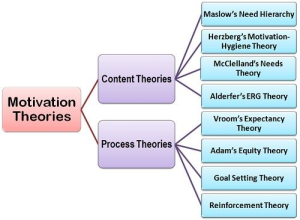
These theories are broadly classified into content theories (focusing on what motivates) and process theories (focusing on how motivation occurs).
The content theories deal with “what” motivates people, whereas the process theories deal with, “How” motivation occurs.
- The Content theories of motivation – The Content theories of motivation focus on what motivates individuals by identifying their needs, desires, and goals. These theories assume that human behavior is driven by internal factors that push people to act in certain ways.
- The Process theories of motivation– The process theories deal with “How” the motivation occurs, i.e. the process of motivation. process theories explain how motivation occurs — the mental and cognitive processes that influence behavior. They emphasize perceptions, choices, and expectations rather than just needs.
- I.Content theories: Focus on what motivates people
- Maslow’s Hierarchy of Needs: Individuals are motivated to fulfill a five-level hierarchy of needs: physiological, safety, social, esteem, and self-actualization.
- Contemporary significance: Managers recognize they must meet employees’ basic needs (fair pay, job security, safe conditions) before focusing on higher-level motivators like recognition and personal growth. Companies address social needs through teamwork and inclusion efforts and esteem and self-actualization through professional development opportunities.
- Significance today: In workplaces, companies offer not only salaries but also career growth, recognition, wellness programs, and meaningful work.
- Herzberg’s Two-Factor Theory: Job satisfaction and dissatisfaction are not opposites. Motivators (achievement, recognition, growth) lead to satisfaction, while hygiene factors (salary, work conditions, company policy) prevent dissatisfaction. Distinguishes between hygiene factors (salary, policies, work conditions) and motivators (recognition, achievement, growth).
- Contemporary significance: This theory is crucial for modern employee retention. Employers must provide good hygiene factors to keep employees from being dissatisfied, but they must also provide motivators for genuine engagement. This influences strategies like job enrichment and recognition programs.
- Significance today: Helps organizations improve job satisfaction by combining fair pay with opportunities for creativity and growth.
- McClelland’s Theory of Needs: This theory suggests that people have three learned needs: achievement. The dominant motivator for an individual depends on their life experiences and can be used to assign suitable roles.
People are motivated by dominant needs: achievement, affiliation, or power.
- Contemporary significance: This is a valuable tool for modern HR. Managers can tailor job roles and rewards based on an employee’s primary motivator. For instance, high-
- Significance today: Employers focus on enriching jobs, providing meaningful work, and balancing financial rewards with intrinsic motivators.
- Alderfer’s ERG Theory: Alderfer’s ERG Theory of Motivation is an extension and simplification of Maslow’s hierarchy of needs. Developed by Clayton Alderfer in 1969, it condenses Maslow’s five levels of needs into three categories: A revision of Maslow’s theory, Alderfer’s model condenses the five needs into three core categories: Existence, Relatedness, and Growth. It proposes that multiple needs can be pursued at once and that people may regress to lower-level needs if higher-level ones are frustrated.
Contemporary significance
- Helps managers understand that employees may seek multiple needs simultaneously (e.g., pay and recognition).
- Explains why employees sometimes shift focus when higher-level needs remain unfulfilled.
- Encourages organizations to provide a balanced mix of financial rewards, good work environment, social connections, and career growth opportunities.
- II Process theories: Explain how motivation occurs
- Vroom’s Expectancy Theory: Vroom’s Expectancy Theory of Motivation is a process theory that explains how individuals make choices regarding various behavioral alternatives based on their expected outcomes. Developed by Victor Vroom in 1964, it focuses on the cognitive process of motivation rather than the types of needs. An individual’s motivation is based on the belief that effort will lead to performance (expectancy), that performance will be rewarded (instrumentality), and that the reward is desirable (valence).
- Contemporary significance: The theory’s focus on perception is vital in today’s workplace. Managers must clearly communicate performance expectations, ensure rewards are tied to performance, and offer rewards that employees genuinely value. This is especially relevant in virtual environments where communication is critical.
- significance today: Especially relevant in performance-based cultures where incentives, bonuses, and career progress depend on measurable outcomes.
- Adam’s Equity Theory: Adams’ Equity Theory of Motivation is a process theory that focuses on fairness in social exchanges and how perceptions of fairness influence motivation. Developed by John Stacey Adams in 1963, it emphasizes that employees are motivated not just by rewards, but by how fairly they are treated relative to others. Employees are motivated by their perception of fairness. They compare their inputs (effort, skills) and outcomes (rewards, recognition) to those of others. Perceived inequity leads to demotivation.
- Contemporary significance: This theory underpins the need for transparent reward systems, fair promotion practices, and equitable compensation. A recent study found that employees who believe they are treated fairly are more likely to stay with a company.
- Significance today: Ensures fairness in salaries, promotions, and opportunities—crucial in the era of diversity and inclusion. Promotes fairness, transparency, and equity in promotions, salaries, and recognition.
Reinforcement Theory: Reinforcement Theory of Motivation is a behavioral theory developed by B.F. Skinner, based on operant conditioning. It focuses on how behavior is influenced by its consequences rather than internal needs or thoughts. Essentially, employees are motivated to repeat behaviors that are rewarded and avoid behaviors that are punished. Behavior is a function of its consequences. Positive consequences encourage a behavior, while negative ones discourage it.
Significance in the Workplace:
- Encourages positive behaviors through rewards.
- Discourages undesirable behaviors through punishment or extinction.
- Helps design effective performance management systems.
- Can be applied in training programs, sales incentives, and team management.
Significance of motivation theories in the contemporary environment
- Targeted strategies: Modern managers use different theories in combination to create personalized motivation strategies. Instead of a one-size-fits-all approach, they tailor incentives and roles to fit individual employees’ needs and drivers.
- Higher employee engagement and retention: By addressing both intrinsic (purpose, growth) and extrinsic (compensation, benefits) motivators, organizations can boost employee engagement, job satisfaction, and loyalty, which helps reduce turnover.
- Diverse and flexible workplaces: The rise of remote, hybrid, and flexible work models has made motivation more complex. Expectancy and self-determination theories help managers understand how to maintain motivation when employees have greater autonomy.
- Competitive advantage: A motivated workforce is more productive, innovative, and committed to organizational goals. Businesses that effectively apply motivational theories gain a significant competitive edge.
Challenges and modern applications : Despite their proven value, applying motivation theories today presents some challenges:
- Complexity of human behavior: The uniqueness of individuals means that a single theory may oversimplify complex human behaviors. Managers must stay flexible and continuously assess what truly motivates their employees.
- The evolving nature of work: As employee needs change over time, motivational strategies must adapt. This requires managers to use performance reviews and open feedback channels to stay updated on employees’ drivers.
- Balancing extrinsic and intrinsic rewards: While extrinsic rewards like fair pay are necessary hygiene factors, an overreliance on them can lead to “reward fatigue.” Effective strategies balance extrinsic rewards with intrinsic motivators like purpose, growth, and recognition.
In contemporary management, motivation theories are a practical toolkit for fostering a thriving, engaged workforce by systematically addressing employees’ diverse needs and aspirations.