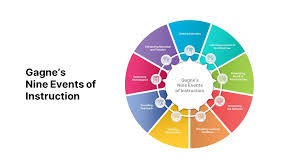
Robert Gagne’s Nine Events of Instruction, also known as Gagne’s Nine Conditions of Learning or Gagne’s Taxonomy of Learning, represents a foundational instructional design model that systematically addresses the cognitive processes essential for effective learning. Originally introduced in his seminal work “The Conditions of Learning” (1965), this framework has been refined and remains highly relevant in contemporary educational practice.
The Nine Events: Updated Framework
1. Gaining Attention (Reception)
Capture learners’ focus through strategic stimuli that prepare the mind for learning. This critical first step activates the learner’s sensory receptors and directs attention toward the learning experience.
Enhanced Strategies:
- Voice modulation, dramatic pauses, and vocal emphasis
- Interactive multimedia presentations and short introductory videos
- Provocative questions or thought-provoking scenarios
- Visual aids, handouts, and digital interactive elements
- Surprise elements or unexpected demonstrations
- Real-world case studies that create cognitive dissonance
2. Informing Learners of Objectives (Expectancy)
Establish clear expectations by communicating learning outcomes, which enhances motivation and provides learners with a roadmap for success. This addresses the “expectancy” component of motivation theory.
Additional Considerations:
- Use SMART objectives (Specific, Measurable, Achievable, Relevant, Time-bound)
- Connect objectives to learners’ personal and professional goals
- Provide both immediate and long-term learning outcomes
- Include assessment criteria and performance standards
3. Stimulating Recall of Prior Learning (Retrieval)
Activate existing knowledge structures to create meaningful connections with new information. This leverages schema theory and cognitive load theory principles.
Extended Approaches:
- Pre-assessment activities to gauge existing knowledge
- Brainstorming sessions and knowledge mapping
- Analogies linking familiar concepts to new material
- Review sessions of prerequisite knowledge
- Collaborative discussions about past experiences
4. Presenting the Content (Selective Perception)
Deliver new information in organized, comprehensible formats that accommodate diverse learning styles and cognitive processing capabilities.
Modern Applications:
- Chunking information into digestible segments
- Multi-modal presentations (visual, auditory, kinesthetic)
- Scaffolded learning with progressive complexity
- Interactive demonstrations and guided discovery
- Digital simulations and virtual reality experiences
- Personalized content delivery based on learning analytics
5. Providing Learning Guidance (Semantic Encoding)
Facilitate deep processing and understanding through strategic support that helps learners encode information meaningfully into long-term memory.
Contemporary Methods:
- Worked examples and cognitive apprenticeship models
- Storytelling and narrative-based learning
- Case-based reasoning and problem-based learning
- Collaborative learning and peer instruction
- Metacognitive strategy instruction
- Just-in-time support and adaptive feedback systems
6. Eliciting Performance (Responding)
Create opportunities for learners to demonstrate their understanding and apply new knowledge, moving from passive reception to active construction.
Diverse Performance Formats:
- Formative assessments and low-stakes quizzing
- Role-playing and simulation exercises
- Project-based learning and authentic tasks
- Peer teaching and explanation activities
- Digital portfolios and reflective journals
- Collaborative problem-solving sessions
7. Providing Feedback (Reinforcement)
Offer timely, specific, and constructive feedback that guides learning and reinforces correct understanding while addressing misconceptions.
Advanced Feedback Strategies:
- Immediate automated feedback in digital environments
- Peer feedback and collaborative evaluation
- Self-assessment tools and rubrics
- Video feedback and personalized comments
- Adaptive feedback based on performance patterns
- Error analysis and corrective instruction
8. Assessing Performance (Retrieval)
Evaluate learning achievement through varied assessment methods that align with stated objectives and provide evidence of mastery.
Comprehensive Assessment Approaches:
- Authentic assessment and performance-based evaluation
- Formative and summative assessment integration
- Portfolio assessment and competency-based evaluation
- Adaptive testing and personalized assessment paths
- Peer assessment and self-evaluation components
- Technology-enhanced assessment tools
9. Enhancing Retention and Transfer (Generalization)
Promote knowledge retention and application to novel situations, ensuring learning extends beyond the immediate instructional context.
Transfer Enhancement Techniques:
- Spaced repetition and distributed practice
- Cross-contextual application exercises
- Reflection and metacognitive awareness activities
- Real-world problem-solving opportunities
- Long-term project assignments
- Professional development and continuing education links
Contemporary Applications and Research
Recent studies demonstrate the continued effectiveness of Gagne’s framework across diverse educational contexts. Research in health professions education shows significant improvements in both theoretical knowledge and clinical practice when instructors implement all nine events systematically. The model’s flexibility allows adaptation to digital learning environments, blended instruction, and competency-based education programs.
The framework aligns effectively with modern learning theories including constructivism, social cognitive theory, and multimedia learning principles. When combined with contemporary pedagogical approaches such as flipped classrooms, active learning strategies, and technology-enhanced instruction, Gagne’s Nine Events provide a robust foundation for instructional design.
Key References
- Gagné, R. M. (1985). The conditions of learning and theory of instruction (4th ed.). Holt, Rinehart & Winston.
- Gagné, R. M., Briggs, L. J., & Wager, W. W. (1992). Principles of instructional design (4th ed.). Harcourt Brace Jovanovich.
- Northern Illinois University Center for Innovative Teaching and Learning. (2020). Gagné’s nine events of instruction: Instructional guide for university faculty.
- Smith, P. L., & Ragan, T. J. (2005). Instructional design (3rd ed.). Wiley.
- University of Florida Center for Instructional Technology and Training. (2018). Gagné’s 9 events of instruction implementation guide.