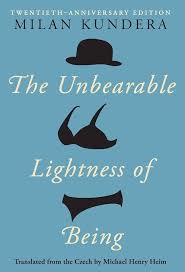
The Unbearable Lightness of Being (1984) by Milan Kundera
The Unbearable Lightness of Being (Czech: Nesnesitelná lehkost bytí) is a 1984 novel by Milan Kundera that follows the intertwined lives of two men, two women, and a dog during the 1968 Prague Spring in Czechoslovakia. Although Kundera completed the work in 1982, it first appeared in 1984 in a French translation (L’insoutenable légèreté de l’être). That same year, an English translation by Michael Henry Heim was released, with excerpts published in The New Yorker. The original Czech edition was published in 1985, and in 1988, the novel was adapted into a feature-length film of the same title.
The Unbearable Lightness of Being tells the story of a young woman in love with a man torn between his love for her and his incorrigible womanizing, and one of his mistresses and her humbly faithful lover. It is a novel about two women, two men, a dog, and their lives in the 1968 Prague Spring period of Czechoslovak history.
Philosophical Foundation
The tale begins on a philosophical note, discussing Friedrich Nietzsche’s concept of eternal recurrence. If, as Nietzsche believed, everything in life happens an infinite number of times, causing the “heaviest of burdens,” then a personal life in which everything happens only once loses its “weight” and significance—hence the “unbearable lightness of being.”
Character Analysis
- Tomas – A successful Prague surgeon who embodies the novel’s central tension between commitment and freedom. His philosophy of “erotic friendship” allows him to separate love from sex, creating relationships devoid of emotional weight while maintaining his marriage to Tereza.
- Tereza – A small-town waitress who becomes Tomas’s wife, representing the “heavy” side of existence through her deep emotional needs and jealousy. Her character struggles with the lightness that Tomas brings to their relationship, desperately seeking meaning and permanence.
- Sabina – Tomas’s primary mistress and a painter who becomes the novel’s ultimate embodiment of lightness. She consistently betrays and abandons relationships before they become too heavy, living a life of perpetual artistic and romantic freedom.
- Franz – A Geneva professor who falls in love with Sabina, representing the opposite of Tomas. Where Tomas seeks lightness, Franz seeks weight and meaning, ultimately leading to his tragic end.
- Karenin – Tereza and Tomas’s dog, who serves as a symbol of innocent, uncomplicated love and provides moments of genuine happiness amid the human characters’ complex emotional struggles.
Historical Context and Political Themes
- Prague Spring 1968 – The novel is set against the backdrop of the Soviet invasion of Czechoslovakia, which crushed the liberalization movement and forced many intellectuals into exile or internal resistance.
- Political oppression – Kundera explores how totalitarian regimes affect personal relationships and individual freedom, showing how characters like Tomas must choose between professional success and personal integrity.
- Exile and displacement – The characters’ forced emigration to Western Europe reflects Kundera’s own experience and examines the psychological cost of leaving one’s homeland.
- Resistance and collaboration – The novel subtly critiques both those who actively resist the regime and those who accommodate it, suggesting that moral choices under oppression are never simple.
Literary Techniques and Style
- Narrative structure – Kundera employs a non-linear narrative that jumps between characters and time periods, reflecting the novel’s themes of repetition and variation.
- Philosophical interludes – The author frequently interrupts the narrative with direct philosophical commentary, creating a unique blend of fiction and essay that became his trademark.
- Musical composition – The novel is structured like a musical composition with recurring themes and variations, appropriate given Kundera’s background as a musicologist.
- Irony and paradox – The text is filled with ironic observations about human nature and the contradictions inherent in existence, particularly regarding the simultaneous desire for freedom and meaning.
Major Themes
- Love versus freedom – The central tension explores whether genuine love requires sacrifice of personal freedom or if freedom can coexist with deep emotional commitment.
- Memory and forgetting – Characters struggle with what to remember and what to forget, both personally and politically, as memory can be both a burden and a treasure.
- Authenticity and performance – The novel questions whether any human behavior is truly authentic or if we are all performing roles dictated by society, politics, or our own self-deception.
- The arbitrary nature of existence – Kundera suggests that life’s events are fundamentally random and that the search for meaning may itself be meaningless.
Cultural Impact and Legacy
- International reception – Upon its initial publication in English and French, the novel enjoyed international popularity, establishing Kundera as a major voice in world literature.
- Film adaptation – The acclaimed 1988 film adaptation directed by Philip Kaufman starred Daniel Day-Lewis (Tomas), Juliette Binoche (Tereza), and Lena Olin (Sabina), bringing the story to a broader audience.
- Literary influence – The novel’s unique blend of philosophical meditation and narrative storytelling has influenced countless contemporary writers and established a new form of intellectual fiction.
- Political significance – The book became an important document of Eastern European experience under communism and contributed to Western understanding of life behind the Iron Curtain.
This magnificent novel juxtaposes geographically distant places, brilliant and playful reflections, and a variety of styles, to take its place as perhaps the major achievement of one of the world’s truly great writers. Through its exploration of love, politics, and philosophy, it continues to resonate with readers grappling with questions of meaning and freedom in their own lives.