Shanghai Cooperation Organisation (SCO) Relevance in Contemporary Environment
The Shanghai Cooperation Organisation (SCO) is a Eurasian political, economic, and security alliance founded in 2001. It is one of the most influential intergovernmental regional organizations in the world.
Origins and evolution
- Shanghai Five (1996):The SCO evolved from the “Shanghai Five” grouping formed by China, Russia, Kazakhstan, Kyrgyzstan, and Tajikistan to address border issues.
- Formation of SCO (2001):Uzbekistan joined the group in 2001, at which point the Shanghai Five was formally renamed the Shanghai Cooperation Organisation.
- Expansion (2017–2024):The organization expanded its membership over time to include India, Pakistan, Iran, and Belarus.
Aims and objectives
The main goals of the SCO are to:
- Strengthen relations and foster mutual trust among member states.
- Promote cooperation in areas such as politics, trade, economy, science, technology, and culture.
- Safeguard regional peace, security, and stability, with a focus on addressing threats like terrorism, separatism, and extremism.
- Work towards creating a more democratic, equitable, and rational international political and economic order.
Structure and membership
- Permanent bodies: The SCO has two permanent bodies: the Secretariat in Beijing and the Executive Committee of the Regional Anti-Terrorist Structure (RATS) in Tashkent.
- Official languages: The official languages of the organization are Russian and Chinese.
Key Member States (as of 2025):
- Founding members: China, Russia, Kazakhstan, Kyrgyzstan, Tajikistan, Uzbekistan
- Newer members: India, Pakistan, Iran
- Observers and dialogue partners: Includes countries like Turkey, Belarus, and others interested in economic partnerships
Strategic importance
The SCO has grown into a major player on the international stage.
- Geographical reach: Its member states cover a significant portion of the Eurasian landmass, representing a large share of the global population and GDP.
- Geopolitical balance: Some observers view the SCO as a strategic counterbalance to Western-led alliances like NATO.
- Economic cooperation: The organization facilitates economic cooperation among its members, including initiatives in trade, infrastructure, and energ
Shanghai cooperation organisation – role in international business
The Shanghai Cooperation Organisation (SCO) plays a growing and strategic role in international business, particularly through its focus on regional economic cooperation, trade, connectivity, and security. Here’s a detailed overview of the SCO’s role in international business:
- Economic and Trade Cooperation
The SCO promotes economic integration and trade among its member states:
- Trade Facilitation: SCO encourages the reduction of trade barriers and simplification of customs procedures among member countries.
- Intra-SCO Trade: It fosters trade relations among its members, which collectively represent over 40% of the world’s population and a significant portion of global GDP.
- Business Forums: The SCO Business Council and Interbank Consortium serve as platforms to promote business-to-business (B2B) engagement, investment, and joint ventures.
- Connectivity and Infrastructure Development
- Transport Corridors: SCO supports initiatives like China’s Belt and Road Initiative (BRI), which aims to build trade and infrastructure networks connecting Asia with Europe and Africa.
- Energy Projects: SCO members collaborate on cross-border energy pipelines, electricity grids, and renewable energy development.
- Investment Promotion
SCO facilitates mutual investments, especially in:
- Energy
- Mining and resources
- Infrastructure
- Agriculture
- Technology and digital sectors
- The SCO Interbank Consortium supports funding for projects through cooperation between banks of member states.
- Enhancing Energy Cooperation
Energy is a major focus for business collaboration:
- Member countries like Russia, China, Kazakhstan, and Iran are major players in oil and gas.
- SCO enables coordination in energy supply, investment in energy infrastructure, and long-term energy contracts.
- Promoting SMEs and Entrepreneurship
- The SCO promotes small and medium-sized enterprises (SMEs) through joint expos, fairs, and forums.
- Encourages knowledge-sharing, tech-transfer, and innovation among businesses in member states.
- Digital Economy and E-commerce
- The SCO is increasingly focusing on digital transformation, supporting cross-border e-commerce and fintech collaboration.
- Promotes cyber security and digital infrastructure cooperation as a foundation for digital business.
- Addressing Non-Economic Barriers
- Security and stability: SCO addresses regional terrorism, extremism, and drug trafficking, creating a stable business environment.
- Legal harmonization: Efforts are made to align legal and regulatory frameworks to facilitate smoother business transactions across borders.
- Expansion of International Influence
- With new members and dialogue partners (e.g., Iran, India, Pakistan), the SCO is extending its global economic influence beyond Central Asia.
- It provides a counterbalance to Western-led economic institutions, offering an alternative platform for cooperation and integration.
SCO summit 2025- Key Facts / Basics
What & when:
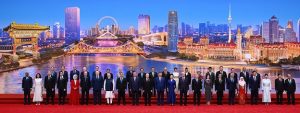
- The 25th SCO Heads of State Council meeting was held from August 31 to September 1, 2025, in Tianjin, China.
- Venue: Meijiang Convention and Exhibition Center in Tianjin. Chairmanship: China held the rotating presidency for 2024–2025 and hosted this summit. After this summit, the chairmanship passed to Kyrgyzstan.
Who Attended
- All 10 full member states of the SCO were present: China, Russia, India, Pakistan, Iran, Kazakhstan, Kyrgyzstan, Tajikistan, Uzbekistan, Belarus.
- Also attended were observer states, dialogue partners, and heads of various international organizations. The summit included a session in the “SCO Plus” format (which brings in more partner/observer states)