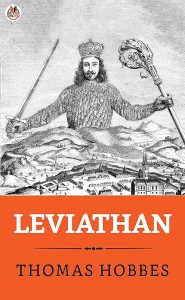
Thomas Hobbes’s Leviathan
Background & Context
- Published in 1651 during the English Civil War, reflecting Hobbes’s direct experience of political chaos and violence
- Full title: “Leviathan or The Matter, Forme and Power of a Common Wealth Ecclesiasticall and Civil”
- Written in exile in Paris after Hobbes fled England due to political tensions
- Influenced by the scientific revolution, particularly geometry and mechanistic philosophy
Core Arguments & Philosophy
The State of Nature
- “War of all against all” – Hobbes’s famous description of life without government
- Life is “solitary, poor, nasty, brutish, and short” in the natural state
- No morality or justice exists without sovereign authority to define and enforce it
- Equality in vulnerability – even the weakest can kill the strongest through cunning or alliance
The Social Contract
- Mutual agreement where individuals surrender natural rights to escape the state of nature
- Absolute sovereignty is necessary – people cannot retain rights that would undermine the sovereign
- Irrevocable consent – once established, the social contract cannot be broken by subjects
- The sovereign is not party to the contract and thus cannot breach it
The Leviathan (Sovereign Power)
- Artificial person created by the collective will of the people
- Absolute authority in legislation, military command, taxation, and religion
- Indivisible power – sovereignty cannot be shared or limited without becoming ineffective
- Purpose is peace and security, not happiness or moral perfection
Political Theory Innovations
- Secular foundation for political authority, not divine right of kings
- Bottom-up legitimacy – government derives power from popular consent, not God
- Materialist approach – humans are physical beings driven by appetites and aversions
- Psychological realism – politics must account for human nature as it is, not as it should be
Structure & Method
- Four parts: Of Man, Of Commonwealth, Of a Christian Commonwealth, Of the Kingdom of Darkness
- Geometric method – builds arguments step by step from basic definitions
- Mechanistic worldview – treats politics like a science with discoverable laws
- Biblical interpretation integrated with political theory to address religious objections
Historical Significance Immediate Impact
- Controversial reception – banned by Parliament, burned at Oxford University
- Influenced Restoration politics and debates about royal authority
- Sparked responses from contemporaries like John Bramhall and Edward Hyde
Long-term Legacy
- Foundation of modern political science – systematic, secular approach to government
- Social contract theory – influenced Locke, Rousseau, and later democratic theorists
- Realist tradition in international relations theory traces back to Hobbes
- Constitutional theory – debates about sovereignty and government power
Contemporary Relevance
- Failed states and civil wars demonstrate Hobbesian insights about order versus chaos
- International relations – states exist in a “Hobbesian” anarchic system
- Emergency powers debates echo Hobbesian arguments about absolute sovereignty
- Social media and “state of nature” – online behavior sometimes resembles Hobbes’s natural condition
Critical Perspectives
Common Criticisms
- Overly pessimistic view of human nature ignores cooperation and altruism
- Justifies tyranny by making any government preferable to anarchy
- Historical inaccuracy – anthropological evidence contradicts “state of nature” claims
- Internal contradictions – absolute sovereignty may be logically impossible
Defenders Argue
- Realistic about power – better to acknowledge political realities than ignore them
- Protective of peace – civil war is indeed worse than imperfect government
- Methodologically sound – thought experiments need not be historically accurate
- Influential framework – even critics use Hobbesian concepts and terminology
Conclusion
Leviathan remains one of the most important works in political philosophy, establishing the modern discourse about state legitimacy, individual rights, and the relationship between power and consent. Whether admired or critiqued, Hobbes’s masterwork continues to shape how we think about government, authority, and human nature in political contexts